Before the Score Sheet: How Games Learned to Keep Track
Learn how game scorekeeping moves from shared memory to visible records, and choose a simple method that keeps points clear without interrupting play.
The most common scorekeeping mistake is waiting until a round ends to write anything down; by then, players may remember the same point differently. Game scorekeeping works best when the group agrees on what counts and records it at a natural pause.
Why do games need a shared record?
In a short game with a few simple turns, players can often keep the score in their heads. A longer game, a larger group, or several kinds of points make that harder: people may lose track of a bonus, a penalty, or whose turn comes next.
There is no single path by which every game adopted scorekeeping. Games developed in different places and traditions, and the evidence for informal play is often limited. A useful general explanation is simpler: players need a shared way to remember results when memory alone stops being convenient.
That record does not have to be written. A group can move counters, use notches, or make marks, provided everyone knows what each one represents. What matters is not the material but the agreed meaning.
How did counters and marks become written scores?
Physical counters and marks are practical ways to make a result visible during play. A counter can stand for a point, while a tally can record a scoring event. These methods are easy to understand in the moment, but they may not show who earned a point or why unless players establish a convention.
Writing offers a different advantage: it can preserve names, rounds, and categories together. A written score does not automatically make a game more accurate; the group still needs to agree on the rules and enter updates at the right time. It does make a record easier to revisit when players pause or resume.
These are useful ways to understand the change, not a claim that all games followed one historical sequence from counters to paper. Different games can use memory, objects, marks, or writing according to what their players need.
What does a written score change?
A visible record gives the group a common reference. Players can see the current position, inspect how a total was formed, and return to a game after a pause without relying on one person’s memory.
More detail also asks for more upkeep. A single running total is easy to read, while a table with rounds and scoring categories can explain where points came from. Choose the smallest record that answers the questions your game actually raises.
A score can shape attention as well as preserve it. Players may focus more on the result when it is visible, or use it simply to keep a long game moving. The group can decide which effect suits the occasion.
How can players keep a score sheet clear?
Before play, agree on when a point counts and who will enter it. Use a pencil and paper for a casual game, or a simple table if rounds or special points need separate tracking.
- Check the player or team names. If two names could be confused, write them out clearly; if everyone is identifiable, use the shorter names the group recognizes.
- Check whether the game has separate rounds. If round results matter later, give each round its own row or column; if only the running total matters, keep one total.
- Check for bonus points or penalties. If they follow different rules from ordinary points, label a separate category; if they do not, include them in the total and state the rule aloud.
- Check who is updating the record. If one person is willing and can see the play, let that person enter scores; if not, rotate the task or have players confirm each entry.
- Check whether a correction might be needed. If the group may need to trace changes, leave room and cross out an old entry legibly; if corrections are unlikely, keep the layout compact.
- Check whether everyone can read the record. If the sheet is hard to see, move it to the center or rewrite it more clearly; if it is already visible, avoid adding decorative marks that obscure the score.
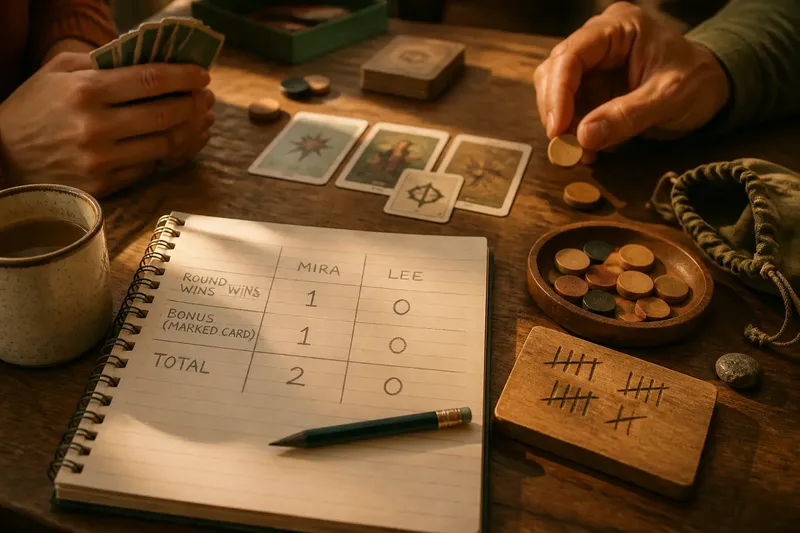
Say you are playing an invented card game with two players, Mira and Lee. The made-up rule awards one ordinary point for a round win and a separate bonus point when a player collects a marked card. First, write Mira and Lee at the top of a sheet and draw columns for round wins and bonuses. After the first round, Mira wins and collects the marked card, so the scorekeeper says both events aloud and enters one point in each of Mira’s columns. The visible result is a record showing Mira’s two points and their different sources; if Lee disputes the bonus, the group can discuss that rule without losing track of the round win.
A custom spreadsheet, elaborate color coding, or a running ledger is not worth the effort for a casual game that ends after a few turns. If maintaining the record takes more attention than playing, simplify it.
What should players do when a score seems wrong?
Pause and identify the disputed event rather than auditing the whole game. Ask what happened, which agreed rule applies, and what the record shows; then correct only the part the group can resolve.
If players cannot agree on what happened, choose a fair way to continue before starting the next round. Depending on the game, the group might replay the disputed turn, leave the point unawarded, or ask a neutral player to help interpret the rule. State the choice and use it consistently.
Recurring confusion usually calls for a clearer method. Add a category for a special point, write down a short symbol key, or ask the player who earned a point to confirm it as it is entered.
What do players still ask about game scorekeeping?
Can players keep score without paper?
Yes. Counters, tokens, or marks can represent points or turns if the group agrees on their meaning. Choose an approach everyone can see and update without interrupting play.
When are tallies better than running totals?
Tallies help show how many scoring events occurred, while a running total makes the current result quicker to read. If the reason for a point matters, add a label or keep separate categories.
Does keeping score make a game more competitive?
A visible score can make comparison more prominent, but it can also serve as a memory aid. Agree on whether the group wants to emphasize ranking or simply keep track of the game’s state.
Who should keep the score?
Any player can do it if the entries are visible and easy for others to check. If the task feels distracting or uneven, rotate it or ask the person who scored to confirm the entry.
How should a group choose its scorekeeping method?
Start with the game’s actual needs: a shared memory may be enough for a brief, simple contest, while counters, tallies, or a written table can help when play has pauses, rounds, or distinct scoring categories. Game scorekeeping is useful when it answers a real question without becoming a second activity.
Keep the record legible, make the scoring rule explicit, and update it before the next play obscures what happened. A small, agreed method can preserve the flow of a game as well as its result.